Your Complete Guide to Business Exit Strategy
Most business owners spend years building a company and a matter of weeks planning how to leave it. Planning your exit properly, including the tax implications, can be the difference between walking away with what your business is truly worth and leaving a significant amount of it behind.
Here we explain all the key factors: the exit routes available to you, the tax implications of each, and how to plan for the best possible outcome.
Most business owners spend years building a company and very little time planning how to leave it. Getting your exit strategy right, including the tax side, can make a significant difference to what you actually walk away with.
Business exit strategies at a glance
Key points:
- What is a business exit strategy? A plan that sets out how you intend to leave your business, when, and on what terms. It covers your goals for the sale, the future of the company, and how you’ll maximise the value you’ve built.
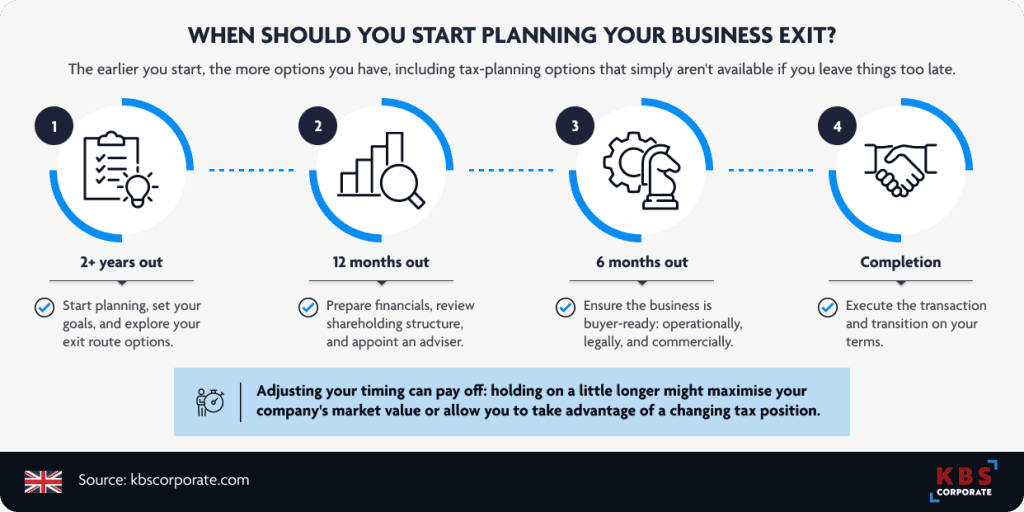
- Who needs one? Every business owner. The earlier you start planning, the more options you have, including tax-planning options that simply aren’t available if you leave it too late.
- What are the main exit routes? There are eight common options: selling to a partner, family succession, management buyout (MBO), trade sale, private equity, IPO, Employee Ownership Trust (EOT), and family offices or institutional investors.
- Which exit route is most tax-efficient? It depends on your circumstances. An EOT currently offers no Capital Gains Tax on a qualifying disposal. MBOs and trade sales can be structured to take advantage of BADR, though the rate has risen to 18% from April 2026.
- What is BADR? Business Asset Disposal Relief reduces the CGT rate on the first £1 million of qualifying lifetime gains. The rate is now 18% for disposals from April 2026, up from 10% before April 2025, so timing matters.
- What should you think about before choosing a route? Your personal goals, a realistic valuation, who will run the business after you leave, whether your documents are in order, and which advisers you’ll work with.
- How do you actually write an exit strategy? Cover five areas: what you want the exit to achieve, your preferred route, the practical steps needed, any liabilities to clear, and a communication plan for staff, shareholders, customers, and suppliers.
- When should you start? At least two years before you intend to sell, ideally earlier. Many of the tax reliefs and eligibility conditions require a qualifying period that must be in place well before the sale begins.
Bottom line: A well-planned exit puts you in control of the price, the timeline, and who the business passes to. Starting early is the single most valuable thing you can do.
What is a business exit strategy?
When you’re selling a business, you must be sure of exactly what you want to achieve. This relates to how you visualise the future; both for yourself, professionally and personally, and for the company and any staff you employ.
Those elements are more important than setting a precise timescale. You may have specific reasons to target an ideal date to complete your exit, but adjusting your timing can pay off. Holding on a little longer might maximise your company’s market value, or allow you to take advantage of a tax position that changes in the months ahead.
Who needs a business exit strategy?
Essentially, every entrepreneur should have an exit strategy, simply because it is beneficial to get ahead of the game. It gives you something to aim for and enables you to make the most of the journey in building up the company to fulfil its potential.
Drawing up your business exit strategy at the earliest opportunity provides direction and generates motivation for you to maximise returns. It also opens up options, including tax-planning options, that simply aren’t available if you leave things too late.
Why is a business exit strategy so important?
Without an exit strategy, you can quickly become reactive, responding to circumstances rather than driving them. A buyer who senses urgency or sees a business without succession depth will use that to negotiate harder on price and terms.
An exit strategy puts you in control, proactively shaping the future of your company rather than leaving it to chance. It also creates the best opportunity to leave on your own terms, knowing the business you’ve given so much to is in the right hands, and that it will continue to stand for what you built.
The benefits of having a business exit strategy
- You will be more incentivised to increase the value of your company
- Your company will be more attractive to acquirers, who will see a business that has been carefully managed financially
- You can ensure an orderly and smooth transition, passing control to whoever you choose
- You can safeguard the future of your company and its staff by making sure it’s passed into the right hands
- When the time comes to sever ties, you will be psychologically prepared for what could be a major lifestyle change
Business exit strategy planning: what to consider
Before you decide on an exit route, there are several key questions to work through:
- Your ambitions: What do you want to achieve from the exit? An immediate or phased withdrawal? How will you deploy the capital, and do you have a wealth management plan in place to make the most of it?
- Your company’s valuation: What is your business worth, and what is it realistically likely to achieve in the market? An experienced business sales adviser can help you arrive at a figure that reflects genuine market demand, not just aspiration.
- Your support team: Who will help you make the business exit strategy a reality? The right advisers make a material difference to both price and process.
- Important documents: Do you have all the key information readily available for the financial due diligence an acquirer will want to undertake?
- Succession planning: If the acquirer doesn’t want a hands-on role or to bring in their own management team, do you have leaders in place ready to step up?
8 types of business exit strategy
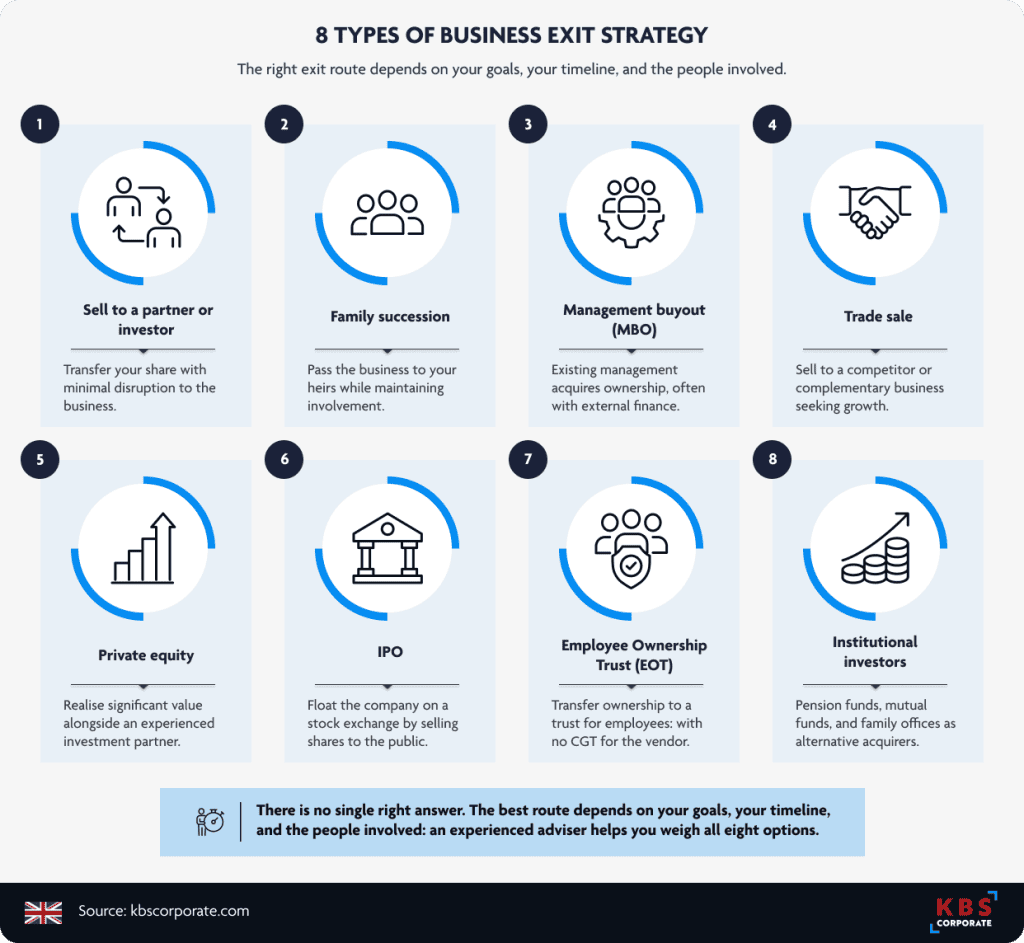
There is no single right answer when it comes to exit strategy. The best route depends on your goals, your timeline, the people involved, and the tax implications of each option. An adviser can help you weigh these up before you commit to a direction. Here are the eight most common options.
1. Selling to a partner or existing investor
If you own the company with someone else, you could sell your share to them. This type of exit strategy is likely to minimise disruption and ensure the company continues to operate as normal.
2. Family succession
This business exit plan could enable you to maintain an involvement with the company and pass your assets to your heirs. It can be wise to involve them in the business at the earliest opportunity, or encourage them to gain experience elsewhere first, bringing a fresh perspective when they eventually take over.
3. Management buyout (MBO)
A management buyout, or MBO, is when the existing management team acquires ownership from the current shareholders, often with an external financing source such as bank debt or private equity.
Because the incoming team already knows the business, MBOs tend to offer a smoother transition than a third-party sale. The tax treatment of an MBO can be highly favourable when structured correctly, which we cover in detail below.
4. Trade sale
One of the most common types of business exit, a trade sale involves selling your company to a competitor or a business in a complementary sector that can see synergies, or is seeking growth in a different geographical area.
5. Private equity
Private equity can allow significant realisation of value whilst positioning the company and its management team alongside a seasoned investment partner. KBS Corporate works closely with a wide range of private equity contacts and have helped clients achieve outcomes that exceeded initial expectations.
6. Initial Public Offering (IPO)
An IPO is the process of selling an equity stake (shares) to the general public in exchange for cash. You would need to partner with an investment bank to underwrite the IPO before, typically, setting an offer period for investors to purchase shares before the company is floated on the stock market.
7. Employee Ownership Trust (EOT)
An EOT (Employee Ownership Trust) is established on behalf of, and for the long-term benefit of, a company’s workforce. The EOT must own 51% or more of the shareholding, but a board of directors will run the company, as there is no requirement to involve employees in day-to-day decision-making.
There are substantial tax benefits for the vendor with an EOT exit, including no Capital Gains Tax on a qualifying disposal.
8. Family offices and institutional investors
Family offices, pension funds, and mutual funds can all be routes to a successful exit, particularly for businesses with stable, recurring revenue and strong fundamentals.
Making your exit tax-efficient: CGT, BADR, and MBO structuring
When you exit is as important as how, but getting both right is what protects the value you’ve built. The tax treatment varies significantly by route, and getting the structure wrong can cost you a material portion of the proceeds, sometimes more than you’d expect.
Capital Gains Tax on a business sale
When you sell a business for profit, the gain is generally subject to Capital Gains Tax (CGT). Every individual has an annual CGT exemption, currently £3,000, which can be offset against gains before tax applies. Following the Autumn Budget 2024, the main rates on business asset disposals are 18% (basic rate) and 24% (higher rate).
Business Asset Disposal Relief
Business Asset Disposal Relief (BADR), formerly known as Entrepreneurs’ Relief, reduces the CGT rate on the first £1 million of qualifying lifetime gains. It doesn’t apply automatically; you need to meet conditions around shareholding, employment, and trading status throughout the two years before sale.
The BADR rate is also changing:
- Up to April 2025: 10%
- April 2025 to April 2026: 14%
- From April 2026 onwards: 18%
Timing and structuring matter. A £1 million qualifying gain completed before April 2025 attracted £100,000 in tax. The same gain after April 2026 will attract £180,000, purely because of when the deal completed.
Getting the timing and structure right is essential. Read our full guide to Business Asset Disposal Relief.
MBO structuring and earn-outs
MBOs (Management Buyouts) often involve deferred consideration or earn-outs, where part of the price depends on future business performance. If an earn-out is linked to your continued employment, HMRC may treat it as income rather than a capital gain, taxed at up to 45% rather than CGT rates. Getting the structure right from the outset is essential.
EOT tax benefits
For qualifying EOT (Employee Ownership Trust) sales, the vendor currently pays no CGT at all on the proceeds, making it one of the most tax-efficient exit routes available where the business and its culture are the right fit.
How to write an exit strategy for a business
When formulating your business exit strategy, these are the elements you need to include:
1. What the exit will achieve for you
Along with the future prospects for your company and its employees, this is the most important factor. Write down what you want your lifestyle to consist of following the exit and how much capital will be needed to facilitate that.
2. Preferred route of exit
Do you plan to pass the company on to family members or the existing management team, or would a completely fresh approach and vision be the best outcome? This may also be influenced by how simple you want the entire process to be, and by the tax implications of each route.
3. Which practical measures need to be taken
Note down the actions needed to ensure the company is operating to maximum effect. It could mean investing in new equipment, facilities, or personnel that will make the company as appealing as possible to a buyer.
4. Potential liabilities
Ensure the financial and administrative side is taken care of. List any debts that should be paid off, settle all supplier invoices and tax liabilities, and make sure contracts and licences are compliant.
5. Work out who needs to know and when
It is essential that all stakeholders find out about a business exit at the appropriate time and not before or after, especially as there are legal implications. Draw up a communication plan encompassing staff, shareholders, customers, and suppliers.
Business exit strategy planning checklist
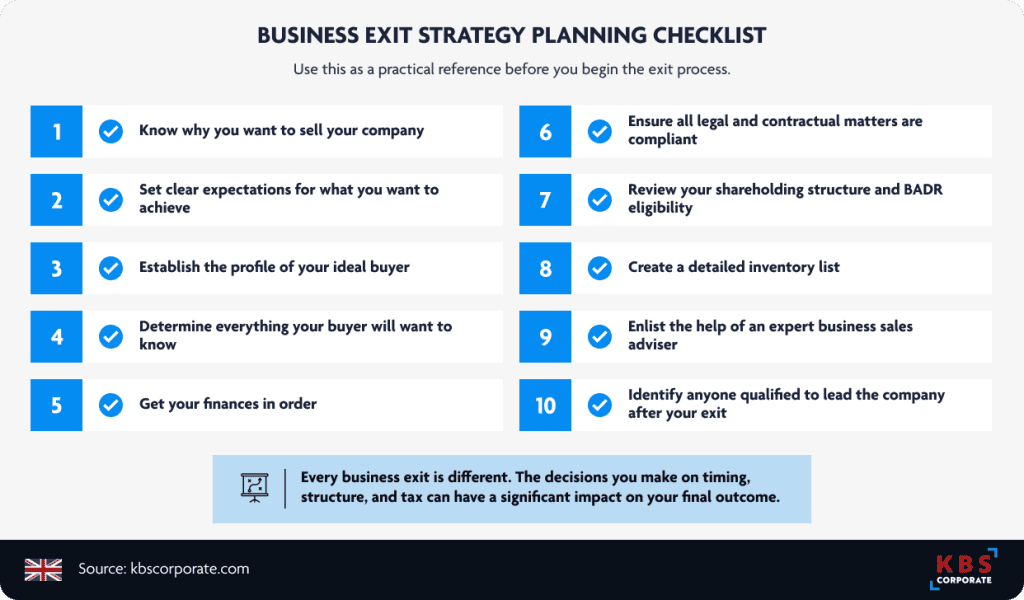
Use this as a practical reference before you begin the exit process.
- Know why you want to sell your company
- Set clear expectations for what you want to achieve
- Establish the profile of your ideal buyer
- Determine everything your buyer will want to know
- Get your finances in order
- Ensure all legal and contractual matters are compliant
- Review your shareholding structure and BADR eligibility
- Create a detailed inventory list
- Enlist the help of an expert business sales adviser
- Identify anyone qualified to lead the company after your exit
When and how to carry out your business exit strategy
Implementing a business exit strategy is not an overnight job; it’s a process that can take years. Here’s our step-by-step summary of what you need to do:
1. Begin as early as possible
It’s advisable to start planning your exit at least two years before initiating a sale process. Build in a wealth management plan which will help you deliver on your exit goals and decide whether you want to remain with the company in any capacity once the transaction has been completed.
2. Team up with the best adviser
At KBS Corporate, we can help with all aspects of a business exit strategy and one of the initial areas we advise on is a suitable valuation for your company. This needs to be managed carefully so that you realise maximum value without setting a price that deters potential acquirers.
3. Work out your succession plan
You may have an obvious candidate in place to step up and lead the company. If so, this aspect of planning is straightforward. However, if not, you will need to pursue an exit strategy that depends on the buyer bringing in their own people.
4. Ensure your company is a well-oiled machine
Everything needs to be ticking along like clockwork to give the best impression to potential buyers. A happy, motivated workforce operating in a clean, modern environment, with all financial and administrative aspects on point.
5. Create a roadmap for the future
A buyer will want to acquire a company for which they can see the potential for considerable growth; a platform on which they can build with their own experience and insight. Make sure you highlight the key revenue streams and areas in which the company is capable of expanding.
Do you need a business exit strategy consultant?
Every business exit is different, and the decisions you make in the months leading up to a sale; on timing, structure, and tax, can have a significant impact on your final outcome.
Whether you are still in the early stages of exit planning or ready to start a process, working with an experienced adviser makes a material difference to both price and outcome.
Built from over 25 years of dealmaking, our database of potential acquirers is one of the most comprehensive in the industry. Find out more about how we can help you sell your company.

Ready to speak to our business sales experts?
Arrange a confidential discussion with a business sales adviser today.
SPEAK TO US Ï
 Ï
 Ï