Business Asset Disposal Relief: What It Means When Selling a Company
Selling a business or shares in a company may result in Capital Gains Tax (CGT) on the gain made by the owner or shareholders. Business Asset Disposal Relief (BADR), formerly known as Entrepreneurs’ Relief, applies a reduced rate of Capital Gains Tax to qualifying gains from the sale of a business, shareholding, or certain business assets.
The relief doesn’t apply automatically. Eligibility depends on several factors, such as the type of sale, how long you’ve owned the business or shares, your role in the company, and whether the company meets the relevant trading requirements.
These conditions should be reviewed well before the sale begins, as leaving it too late can mean missing eligibility requirements that need to be in place for a set period before the disposal. In this guide, we cover how Business Asset Disposal Relief works, who may qualify, and what business owners should check before starting the sale process.
Business Asset Disposal Relief at a Glance
If you’re selling a company, BADR could reduce the Capital Gains Tax you pay on the proceeds, but it doesn’t apply automatically, and the conditions need to be in place well before the sale begins.
Key points:
- What is BADR? Business Asset Disposal Relief (formerly Entrepreneurs’ Relief) applies a reduced rate of Capital Gains Tax to qualifying gains when you sell a business, shares, or certain business assets. It’s available to individuals, not companies.
- What’s the current rate? For disposals made on or after 6 April 2026, the BADR rate is 18%, compared to the standard CGT rate of 24%. Earlier disposals attracted lower rates; 14% between April 2025 and April 2026, and 10% before that.
- Is there a limit? Yes. Each individual has a £1m lifetime limit on the qualifying gains that can benefit from BADR. Previous claims under BADR or Entrepreneurs’ Relief reduce what’s left.
- Who qualifies? Eligibility depends on what you’re selling and your role in the business. Shareholders selling shares in a limited company must generally have held at least 5% of the shares and voting rights and been an employee or office holder for at least two years before the sale. Sole traders and partners have their own set of conditions.
- Does the sale structure matter? Yes. In a share sale, individual shareholders may be able to claim BADR on their gain. In an asset sale, the company pays Corporation Tax on any gains and BADR isn’t available to the company itself, which can produce a very different outcome even if the headline price is the same.
- What could stop you from qualifying? Common pitfalls include not meeting the two-year qualifying period, holding less than 5% of the shares, not being an employee or office holder, or selling shares in a company that doesn’t meet the trading requirements. Changes to the ownership or share structure can also affect eligibility.
- How do you claim it? BADR isn’t applied automatically. You need to claim through the Capital Gains Tax section of your Self-Assessment tax return, and the deadline is generally 31 January in the second year after the tax year in which the disposal took place.
Bottom line: BADR can make a meaningful difference to the tax you pay when selling a company, but the eligibility conditions need to be reviewed, and ideally met, well before the sale process begins. Early tax advice is the best way to understand your position.
What is Business Asset Disposal Relief?
Business Asset Disposal Relief (BADR) is a CGT relief available to individuals who dispose of certain qualifying business interests or assets. It was known as Entrepreneurs’ Relief until April 2020, which is why both names are still widely used.
BADR may apply when an individual sells:
- All or part of a sole-trader or partnership business
- Shares in a qualifying trading company
- Certain assets connected with their withdrawal from a business
- Qualifying business assets following a business closure
BADR applies to the qualifying capital gain rather than the total sale price. It doesn’t remove the tax liability entirely. Instead, it applies the BADR rate to eligible gains within the seller’s remaining lifetime limit.
Understanding the BADR lifetime limit
The lifetime limit is the cumulative amount of qualifying gains that may benefit from BADR. It is currently £1m per individual, and any previous BADR or Entrepreneurs’ Relief claims reduce the amount remaining.
Companies don’t claim BADR themselves. When company shares are sold, it’s normally the individual shareholders who consider whether BADR applies to gains arising from the disposal.
How does Business Asset Disposal Relief work?
When a qualifying disposal is made, the capital gain arising from the transaction must first be calculated. This typically involves deducting the allowable cost of the relevant shares or assets, together with any permitted expenses, from the amount received.
The gain is then considered alongside any allowable losses, the individual’s annual exempt amount, and their remaining BADR lifetime limit. The applicable BADR rate is charged on the portion of the gain that qualifies for relief.
Normal Capital Gains Tax rules apply to gains that don’t qualify or exceed the seller’s remaining lifetime limit. The final tax liability therefore depends on the individual’s circumstances, as well as the timing and structure of the sale.
What is the current Business Asset Disposal Relief rate?
The Business Asset Disposal Relief rate is determined by when the qualifying disposal takes place. For disposals made on or after 6 April 2026, qualifying gains within the seller’s available lifetime limit are taxed at 18%.
The rate was previously 14% for disposals made between 6 April 2025 and 5 April 2026, and 10% for disposals made on or before 5 April 2025.
| Date of disposal | BADR rate |
| On or before 5 April 2025 | 10% |
| 6 April 2025 to 5 April 2026 | 14% |
| From 6 April 2026 | 18% |
Table 1: BADR rates by date of qualifying disposal.
The standard Capital Gains Tax rate on gains above an individual’s available basic-rate band is generally 24%. For these gains, BADR may reduce the applicable rate to 18%, provided the disposal qualifies and the individual has not exhausted their lifetime limit.
The difference BADR makes depends on the seller’s:
- Income
- Other gains
- Available losses and allowances
- Remaining BADR lifetime limit (the amount of qualifying gains that may still receive the BADR rate)
Tax rates may change, so it’s a good idea for business owners to check the latest position and seek professional tax advice before completing a disposal.
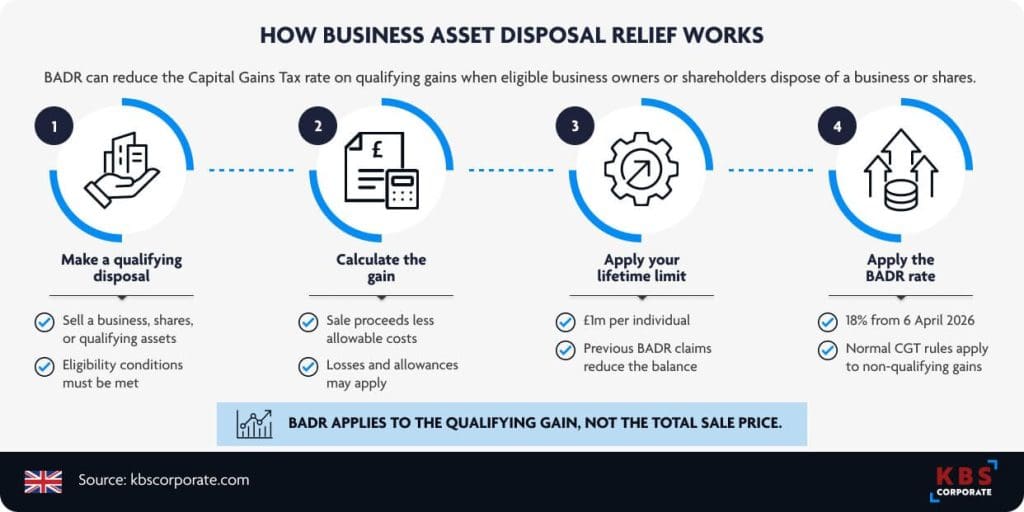
Visual 1: BADR reduces the rate of Capital Gains Tax on qualifying gains, not the total sale price. From April 2026, the relief applies at 18% up to the £1m lifetime limit.
Who is eligible for Business Asset Disposal Relief?
Eligibility for Business Asset Disposal Relief depends on what is being sold and the seller’s relationship with the business. Different conditions apply to company shareholders, sole traders, business partners, and individuals selling assets after a business has stopped trading.
For example, shareholders must normally satisfy employment and ownership tests, while sole traders are assessed against conditions relating to their ownership and disposal of the business.
Most of the relevant conditions must be satisfied throughout a qualifying period of at least two years. However, meeting one requirement, such as owning shares for two years, doesn’t automatically mean the disposal will qualify.
Selling shares in a limited company
If you’re selling shares in a limited company, you may qualify for BADR if you meet the relevant employment, shareholding, and company trading requirements.
For at least two years before the sale, you must normally:
- Be an employee or office holder of the company, or another company within the same group
- Hold at least 5% of the company’s ordinary share capital
- Control at least 5% of the company’s voting rights
- Be entitled to at least 5% of the company’s distributable profits and winding-up assets, or its sale proceeds
- Hold shares in a trading company or the holding company of a trading group
See our guide to selling a limited company for more detail on the wider sale process.
Selling a sole-trader or partnership business
Sole traders and business partners may qualify for BADR when selling all or at least a qualifying part of their business. If this is your situation, you must normally have owned the business for at least two years up to the date of disposal.
Where only part of your business is sold, that part must generally be capable of independently operating as a business. If you sell an individual asset, such as a business premises, vehicle, or equipment, it won’t necessarily qualify just because it was used by the business.
Different rules may apply where a personally owned asset is sold in connection with the owner’s wider withdrawal from a company or partnership. This is known as an associated disposal and is subject to additional conditions.
Selling EMI shares
If you’ve acquired shares through a qualifying Enterprise Management Incentive (EMI) option, you don’t need to meet the usual 5% shareholding and voting-rights requirements.
This is because qualifying EMI shares come under separate BADR rules designed for employee share options, where individuals often hold a much smaller interest in the company.
Instead, the EMI option must normally have been granted at least two years before the shares are sold, and the shares have been acquired after 5 April 2013. You must also satisfy the relevant employment conditions, while the company must meet the applicable trading requirements.
Selling assets after a business has ceased trading
It’s possible for BADR to apply when qualifying business assets are sold after a sole-trader or partnership business has stopped trading.
If you find yourself in this position, you must normally have owned the business for at least two years up to the date it ceased. The assets must have been used by the business when it stopped trading and must usually be sold within the following three years.
Different rules apply to company shareholders. A company’s shares may still qualify for BADR if it stops being a trading company, provided the shares are sold within three years. The shareholder must normally have met the relevant BADR conditions for at least two years prior to the date the trading stopped.
Selling within the three-year period does not guarantee eligibility. You’ll also need to consider the type of asset, its previous use, and the circumstances of the disposal.
Business Asset Disposal Relief conditions at a glance
Before taking BADR for granted as part of a business sale, it’s a good idea to consider the following questions:
- What is being sold: company shares, a sole-trader business, a partnership interest, or individual assets?
- Qualifying period: have the relevant conditions been met for at least two years?
- Role in the company: is the shareholder an employee or office holder?
- Ownership: are the applicable shareholding and voting-rights requirements met?
- Trading status: is the company a trading company or the holding company of a trading group?
- Previous claims: has the seller already used any of their BADR lifetime limit?
- Recent changes: have changes to the business, share structure, or trading activity affected eligibility?
- Sale structure: could the proposed transaction change who sells the assets or incurs the tax liability?
Our checklist provides an initial indication only. BADR eligibility depends on your individual circumstances, your business, and the proposed transaction.
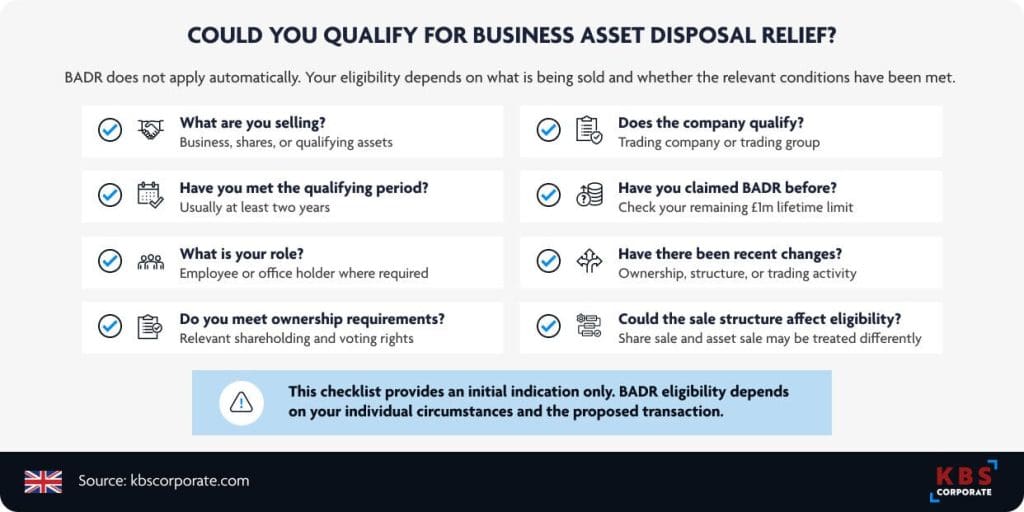
Visual 2: Eligibility for BADR depends on a number of factors including what you’re selling, your role in the business, the qualifying period, and your shareholding. This checklist provides an initial indication only. Always seek professional advice before relying on BADR in your sale planning.
What is the Business Asset Disposal Relief lifetime limit?
The BADR lifetime limit is currently £1m of qualifying gains per individual. Key points to take into account include:
- The limit applies across an individual’s lifetime and does not reset each tax year
- Previous BADR or Entrepreneurs’ Relief claims reduce the amount remaining
- Once the limit is used, further gains are taxed under the normal Capital Gains Tax rules
- Spouses and civil partners each have their own limit, but must qualify independently
Any previous claims under BADR or its former name, Entrepreneurs’ Relief, reduce the amount remaining. Using part of the lifetime limit doesn’t prevent a later disposal from qualifying, but it reduces the amount of that later gain that may receive the BADR rate.
For example, someone who has already claimed BADR on gains of £400K may have £600k remaining. BADR could apply to that portion of a later qualifying gain, with normal Capital Gains Tax rules applying to the balance.
Joint ownership or transferring shares does not automatically make you eligible. So, professional tax advice should be obtained before changing an ownership structure. Our colleagues at K3 Tax Advisory can help with the tax implications of ownership changes.
How much could Business Asset Disposal Relief save?
As with eligibility, there isn’t a single quick answer. The potential tax saving depends on:
- The size of the qualifying gain
- The seller’s remaining BADR lifetime limit
- Their income and other gains
- Any available losses and allowances
- The Capital Gains Tax rate that would otherwise apply
For example, an individual makes a qualifying gain of £500k and has not previously used any of their BADR lifetime limit. If the gain would otherwise be taxed at 24%, the simplified calculation would be:
| Tax treatment | Illustrative tax |
| £500k at the 18% BADR rate | £90k |
| £500k at the 24% standard CGT rate | £120k |
| Potential difference | £30k |
Table 2: Example of the potential tax saving available through BADR.
Note: This is a simplified example and does not account for the annual exempt amount, other gains, losses, or the seller’s wider circumstances. A tax adviser should calculate the potential saving based on the individual transaction.
What could prevent you from qualifying?
BADR has several detailed requirements, and failing to meet one of them may prevent or restrict a claim.
Common pitfalls to avoid include:
- Not meeting the relevant two-year qualifying period
- Holding less than 5% of the company’s ordinary share capital or voting rights
- Not being an employee or office holder of the company
- Failing to hold at least 5% of the company’s distributable profits and winding-up assets, or its sale proceeds
- Selling shares in a company that doesn’t meet the specified trading requirements
- Selling an individual asset rather than a qualifying business or part of a business
- Selling qualifying assets more than three years after a sole-trader or partnership business stopped trading
- Changing the ownership or structure of the business without considering the effect on BADR
The trading-company requirements can be particularly complex where a company carries out investment activity alongside its main trade or holds substantial assets that aren’t used for trading. The business’s overall circumstances should be considered rather than relying on a single figure or balance-sheet item.
Relief on an asset connected with a wider business disposal may also be restricted. For example, this could happen where the asset was only used by the business for part of the ownership period or the business paid rent to use it.
Some scenarios may be covered by specific exceptions. That said, these rules are complex and should not be relied on without advice from a specialist tax adviser.
Does the structure of a business sale affect BADR?
Yes, the structure of a business sale determines who sells the business, who receives the proceeds, and which taxes may apply.
For a limited company, there is an important distinction between shareholders selling their shares and the company selling its trade and assets.
Selling shares in a company
During a share sale, the shareholders sell their shares to the buyer. While the company continues to own its trade, assets, and liabilities, its ownership changes.
Any gain is usually made by the individual shareholders. They may be able to claim BADR if they and the company meet the relevant requirements.
It’s likely a buyer will examine the company’s financial, legal, and commercial position in detail because they are acquiring the business together with its existing obligations. As a result, they could request warranties, indemnities, and other protections in place during business sale negotiations.
A company selling its trade and assets
An asset sale involves the company selling some or all of its trade and assets rather than the shareholders selling their individual shares.
The company may pay Corporation Tax on gains arising from the assets it sells, as BADR isn’t available to the company itself. Further tax considerations may arise when the sale proceeds are later paid or distributed to shareholders.
An asset sale can therefore produce a different result from a share sale, even where the headline price is almost identical. The nature of the assets being transferred, the treatment of liabilities, and how the proceeds reach the owners all require careful review.
The position differs for sole traders and partnerships because their business assets aren’t owned through a separate limited company. The circumstances and tax treatment of each disposal should therefore be checked individually.
Read our guide to tax when selling a business for a broader overview of the potential tax implications.
Why consider BADR before selling your business?
BADR should be considered before marketing your business for sale or agreeing detailed terms. If you leave the review until a transaction is already under way, you may end up with less time to identify and address potential issues.
Getting ahead of the game can help you answer important questions:
- Is the proposed disposal likely to qualify?
- Has the two-year qualifying period been met?
- Does the seller meet the employment and ownership requirements?
- Does the company meet the relevant trading conditions?
- How much of the seller’s BADR lifetime limit remains?
- Could the share or sale structure affect eligibility and tax treatment?
- What records may be needed to support a future claim?
While early planning doesn’t guarantee that BADR will be available, it can put eligible sellers in a stronger position before the sale begins. Any restructuring, share transfer, or change in employment status should be considered carefully with professional tax and legal advisers.
Read our guide to integrated tax advice in business exit planning to understand why tax should be considered alongside the wider sale process.
How and when do you claim Business Asset Disposal Relief?
BADR isn’t applied automatically; you need to make a direct claim to HMRC.
A claim can normally be made through the Capital Gains Tax section of your Self-Assessment tax return. Where a claim cannot be made through the return, it may be possible to claim in writing or by using the relevant section of HMRC’s BADR helpsheet.
The deadline is generally the first anniversary of 31 January following the end of the tax year in which the qualifying disposal took place.
For example, a disposal made during the 2025/26 tax year must generally be claimed by 31 January 2028.
A claim should include:
- An accurate calculation of the qualifying gain
- Records showing how the eligibility conditions were met
- Evidence of how much of the lifetime limit has already been used
Submitting a claim alone doesn’t confirm that the disposal qualifies. HMRC may review the claim and request evidence supporting your eligibility and calculation.
Selling your company with BADR
Business Asset Disposal Relief is only one part of the financial and commercial planning involved in a successful business sale. Preparing early gives you time to identify potential tax issues, review the proposed sale structure, and strengthen your position before negotiations begin.
Find out more about selling a company and how KBS Corporate supports business owners from initial preparation and valuation through to buyer negotiations and completion.
Business Asset Disposal Relief: FAQs
Yes. Entrepreneurs’ Relief was renamed Business Asset Disposal Relief in April 2020 and has been known as that ever since.
Earlier Entrepreneurs’ Relief claims still count towards the individual’s BADR lifetime limit. The name changed, but the two reliefs count towards the same lifetime limit.
No. Selling a business doesn’t automatically mean the disposal qualifies for BADR. The relevant ownership, employment, shareholding, and trading conditions must be met.
Even where the conditions are satisfied, BADR isn’t applied automatically. A claim must be made to HMRC.
BADR applies to the qualifying capital gain rather than the total sale price.
The gain is broadly based on the amount received, less the allowable cost of the shares or assets and certain permitted expenses. Other gains, losses, and allowances may also affect the final calculation.
An individual can make more than one BADR claim, provided each disposal qualifies and some of their lifetime limit remains.
The £1m lifetime limit applies to cumulative qualifying gains rather than each company sale or tax year.
It’s possible that both spouses or civil partners can claim BADR, but each person must independently meet the relevant conditions. Each also has their own lifetime limit. Simply transferring or jointly owning shares doesn’t guarantee that both individuals will qualify.
BADR may apply to qualifying business assets sold within three years of a sole-trader or partnership business ceasing to trade, providing the relevant conditions were met before it stopped trading.
Shares can also qualify when a company has stopped being a trading company and the shares are sold within three years. Other eligibility conditions still apply, however.
It depends on who owns and sells the assets and whether the disposal meets the relevant conditions.
BADR isn’t available to a limited company selling its own assets, for example. However, it can apply to certain disposals made by sole traders, partners, or individuals selling assets as part of their withdrawal from a business.
BADR only applies to the portion of the gain that falls within your remaining lifetime limit. The balance above that limit is taxed at the normal CGT rate. For example, say you have £600k of your lifetime limit left and make a qualifying gain of £900k. In this case, BADR would apply to £600k and normal CGT rules would apply to the remaining £300k.

Ready to speak to our business sales experts?
Arrange a confidential discussion with a business sales adviser today.
SPEAK TO US Ï
Ï
 Ï
Ï
 Ï
Ï