

Due Diligence When Buying & Selling a UK Business
Due diligence is a term you’ll encounter at every stage of a business transaction. Whether you’re buying a company, selling one, or advising on either side, it describes the process of checking that what’s on the table is what it appears to be.
In a business sale context, it’s the stage where the deal either gets confirmed or gets complicated. Buyers use it to test assumptions and assess risk. Sellers who understand it in advance, and prepare for it properly, are far better placed to protect their valuation, avoid delays, and get to completion with confidence.
This guide covers everything you need to know, including what due diligence involves, the different types, what documents sellers need to prepare, how long it takes, and how to protect your position throughout the process.
Due Diligence at a Glance
Whether you’re buying or selling a UK business, due diligence is the stage where the deal either gets confirmed, or gets complicated. Here’s what you need to know.
Key points:
- What is due diligence? It’s the structured process of independently checking a business before committing to a deal, covering finances, legal position, contracts, and operations.
- What do buyers actually look at? Certifications, insurance, employee contracts, client relationships, supplier arrangements, and major contracts; anything that reveals risk or affects the value of what they’re buying.
- How does the process work? It usually kicks off after Heads of Terms are agreed. The buyer issues a request list, the seller provides documents via a data room, and both sides work through findings until deal terms are finalised.
- How long does it take? Typically 4–10 weeks, depending on the size and complexity of the deal. Disorganised records, unresolved disputes, or incomplete contracts all add time.
- What types of due diligence are there? Financial, legal, commercial, tax, HR, operational, and regulatory; most larger deals run several of these in parallel. Smaller or lower-risk deals may use a faster red-flag review instead.
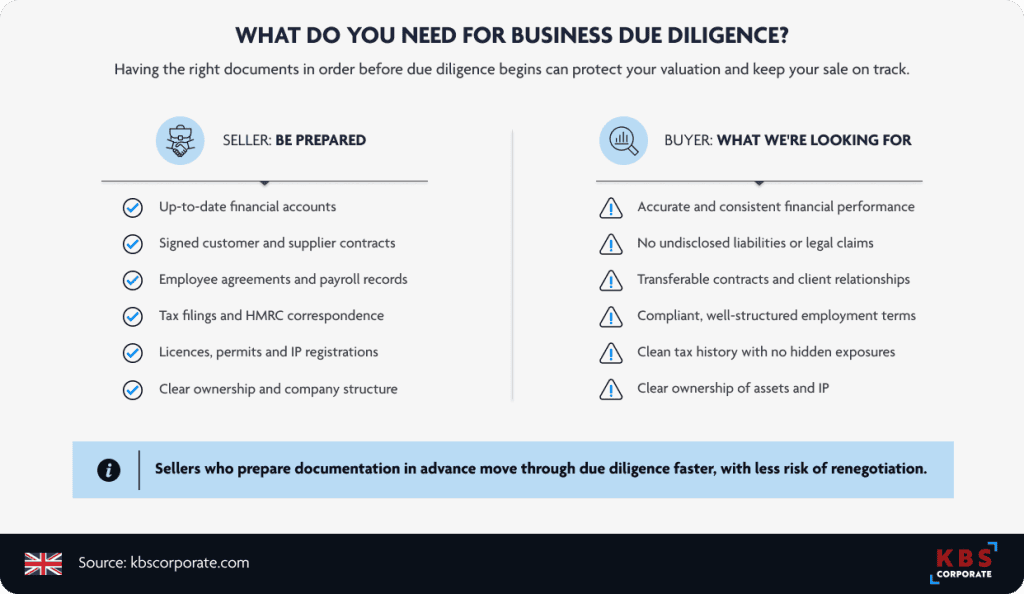
- What documents does a seller need? Audited accounts, tax filings, employment contracts, customer and supplier agreements, IP registrations, licences, and compliance records; organised and ready to share.
- Can due diligence change the price? Yes. If buyers uncover undisclosed liabilities, compliance gaps, or customer concentration risk, they have grounds to renegotiate. Most issues are resolved through retentions, earn-outs, or warranties rather than outright price cuts.
- How should sellers prepare? The article sets out a six-step checklist: appoint an adviser early, carry out an internal review, organise your documents, use NDAs, release information in stages, and work with a full-cycle adviser who can manage the process end to end.
Bottom line: Buyers are taking significantly longer to scrutinise acquisitions than they were a decade ago. Sellers who prepare early move faster, protect their price, and give buyers far less to push back on.
What is due diligence?
Due diligence is the process of independently verifying information before making a significant decision or commitment. The term applies broadly across law, finance, property, and business, but the principle is the same in every context; check before you commit.
In a business sale, due diligence is the structured investigation a buyer carries out before buying a business. It involves a thorough review of the business’s financial, legal, and operational position to confirm the seller has provided an accurate representation of what’s being sold.
Buyers conduct due diligence to:
- Verify the accuracy of the company’s financial, legal, and operational information
- Identify liabilities or risks that could impact the deal
- Assess commercial viability and long-term sustainability
Effective due diligence is a two-way street, but for sellers, being unprepared can cause serious delays or raise red flags. Sellers who prepare well can anticipate concerns, address them proactively, and protect both the deal timeline and the final price.
What do buyers check?
During due diligence, a seller will be presented with many legal due diligence enquiries that help a buyer gather evidence and confirm key assumptions. Requests typically focus on the business’s financial and legal position, including:
- Certifications and regulatory compliance
- Insurance
- Employee contracts and key staff terms
- Client relationships and major contracts
Buyers focus on these areas because they reveal potential legal and operational risks, test whether the business can continue to operate smoothly after completion, and help validate the long-term value of the acquisition.
Employee contracts and key staff terms receive particular attention. Where the sale involves a business or service transfer, TUPE may apply, and buyers will want to understand staff terms, continuity of employment, and any outstanding employment matters before completion. See our guide to TUPE and employment law when selling a business.
The business due diligence process
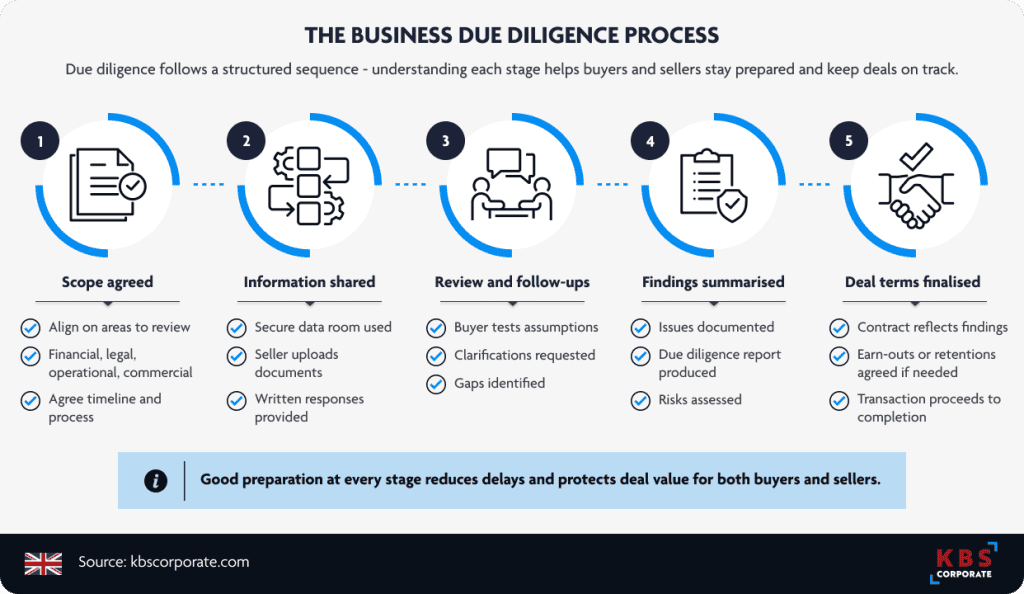
Due diligence in mergers and acquisitions usually begins after Heads of Terms (HoT) are agreed. The buyer shares a due diligence request list, and the seller provides documents and written responses, often via a secure data room.
The buyer then reviews the information, asks follow-up questions, and uses the findings to validate the agreed price and finalise deal terms.
In practice, this is how the process usually looks:
- Scope agreed: this includes what will be reviewed, such as financial, legal, operational, and commercial
- Information shared: documents provided and initial questions answered
- Review and follow-ups: buyer tests assumptions and requests clarifications
- Findings summarised: issues and risks documented in a due diligence report
- Deal terms finalised: outcomes reflected in the contract, including any earn-outs or deferred consideration
Share purchase vs asset purchase
Most UK business sales proceed as a share purchase, where the buyer acquires the company in full, including all liabilities, both known and unknown. This makes due diligence more extensive, as the buyer needs to be satisfied about every aspect of the company’s history.
In an asset purchase, the buyer selects which assets and liabilities to take on, making due diligence more focused. Your adviser will help you understand which structure applies and what it means for your obligations and tax position.
Read our guide to BADR (Business Asset Disposal Relief) for more on tax position upon exit.
Due diligence when buying a business
When buying a business, due diligence confirms whether the company is as it has been described and helps the buyer understand material risks before committing. Buyers typically focus early on the areas most likely to affect deal value or cause problems post-completion.
Key areas of focus include:
- Contracts: are key customer and supplier agreements transferable and on favourable terms?
- Liabilities: are there outstanding debts, HMRC liabilities, or undisclosed claims?
- Compliance: does the business hold the licences and approvals it needs to operate?
- Customer concentration: what percentage of revenue comes from the top few clients?
- Supplier dependency: is the business reliant on a single supplier with no backup?
- Key-person risk: is performance tied to one or two individuals who may leave after the sale?
The goal is to confirm there are no unexpected issues, that the business is fairly priced, and that risk is clearly understood before completion.
Due diligence when selling a business
When selling a business, the goal is to keep due diligence as efficient as possible. That way, delays are minimal, which means less risk of deal fatigue, buyer renegotiation, or a reduced offer. Preparation is the most effective tool a seller has.
Research indicates a 64% increase in due diligence processing time over the last decade, as buyers are scrutinising acquisitions more thoroughly than ever. Sellers who prepare well move faster, maintain buyer confidence, and are far less exposed to last-minute price challenges.
To keep the process on track, it’s a good idea to prepare important documents ahead of time and respond quickly to any follow-up questions. Below, the sections on documents and our six-step checklist cover exactly what to do.
The video below outlines the key financial considerations sellers should address before entering due diligence.
For a broader view of the sale process, see our guide on how long it takes to sell a business.
How long does due diligence take?
Timelines can vary based on the size of the business and the complexity of the deal, but due diligence typically takes around 4-10 weeks from the initial request list to agreed findings and final legal terms.
Smaller, well-prepared transactions can move faster, while more complex acquisitions (such as those involving regulated sectors, overseas elements, or incomplete records) take longer.
Signs due diligence is likely to take longer:
- Documentation is incomplete or poorly organised
- There are complicated contracts, tax issues, or ongoing disputes
- The buyer needs specialist reviews (legal, financial, HR, IT)
- Issues are uncovered that require negotiation or fixes before completion
If you’re selling, preparing a clear due diligence pack in advance and responding quickly to any follow-up questions are the most effective ways to keep things moving.
Types of due diligence
Not all due diligence looks the same. The type and depth of investigation depends on the transaction’s size, complexity, and risk profile.
In corporate due diligence, buyers typically carry out checks across several areas simultaneously, and may apply enhanced scrutiny where the risk warrants it.
The table below covers the main areas a buyer will review in a standard transaction:
| Types of Due Diligence | What it Involves | Why it Matters to Buyers |
| Financial Due Diligence | Examination of financial records, cash flow, working capital, EBITDA, debt & forecasts. | Validates earnings and financial health; helps buyers assess value & sustainability. |
| Legal Due Diligence | Review of contracts, ownership, IP rights, compliance, litigation & liabilities. | Identifies legal risks & ensures the business is in good legal standing. |
| Commercial Due Diligence | Analysis of market position, customer base, competitors & commercial strategy. | Evaluates growth potential & verifies strategic alignment with buyer goals. |
| Tax Due Diligence | Review of tax compliance, liabilities, structures & past filings. | Highlights opportunities for tax-efficient structuring. |
| HR/Employment Due Diligence | Investigation of employment contracts, benefits, disputes, pensions & organisational structure. | Assesses workplace liabilities & potential risks associated with integration. |
| Operational Due Diligence | Reviews of processes, systems, supply chains, premises & technology. | Identifies operational efficiencies or limitations that may affect performance. |
| Regulatory Due Diligence | Examination of industry-specific regulations, licences & compliance measures. | Ensures the business adheres to regulatory frameworks & avoids penalties. |
Beyond the standard areas above, due diligence can also be categorised by approach and depth, depending on the size and risk profile of the deal.
Hard due diligence
Hard due diligence focuses on the evaluation of concrete data that is, typically, easily obtainable. This is a common process that consists of a fundamental analysis of financial statements, including:
- balance sheets
- projections
- income statements
Additional factors include reviewing ongoing litigation and subcontractor relationships. Hard due diligence is driven by mathematics and legalities.
Soft due diligence
Soft due diligence looks beyond the numbers at the people and relationships that keep the business running. This includes the management structure, culture, and key-person risk, as well as the strength and stability of the customer base. It helps balance the financial review so important non-financial risks aren’t missed.
Red-flag due diligence
A faster, focused review used in smaller or lower-risk transactions. Rather than a full deep-dive, the buyer concentrates only on potential deal-breakers like material liabilities, litigation, compliance failures, and ownership clarity.
Common in time-pressured or lower-value deals where a full review would be disproportionate.
Enhanced due diligence (EDD)
Enhanced due diligence (EDD) involves deeper checks where the risk profile is higher.
For example, businesses subject to financial regulation or supervised by the Financial Conduct Authority (FCA), transactions with links to high-risk jurisdictions, or situations involving politically exposed persons (PEPs).
Factors leading to EDD include:
- Higher-risk countries and business sectors
- Complex or opaque beneficial ownership structures
- Unusual transactions that lack an obvious economic or lawful purpose
Business partner screening
Business partner screening is a form of corporate due diligence used to assess third parties the business relies on, such as partners, joint venture participants, or key suppliers.
It helps identify legal, financial, or reputational risks by building a clearer picture of a counterparty’s background. In the context of mergers and acquisitions, business partner screening can support wider M&A due diligence by highlighting third-party risks that may affect operations or value after completion.
Due diligence documents at a glance
Assembling the right documentation is one of the most important steps a seller can take. Each area of due diligence requires specific information, and inconsistencies or gaps can raise red flags that delay the process or give buyers negotiating leverage.
Preparing documents early keeps you in control and avoids last-minute surprises.
| Type of Due Diligence | Documents Required | Purpose |
| Financial Due Diligence | Audited & management accounts; cash flow statements & financial forecasts; loan & debt details; fixed asset register | Verify revenue, profitability, financial stability and working capital |
| Legal Due Diligence | Company formation documents; shareholder agreements; litigation history; Intellectual Property ownership & registrations | Identify legal risks, ownership clarity and contract validity |
| Commercial & Operational | Business plan & strategy; customer contracts; supplier agreements; CRM & sales reports | Assess market position, recurring revenue and operational scalability |
| Tax Due Diligence | VAT & Corporation Tax filings; HMRC correspondence; R&D claims; group structure & inter-company agreements | Uncover hidden liabilities and optimise post-sale tax structure |
| HR & Employment Due Diligence | Employee contracts & policies; payroll records; pensions & benefits details; staff disputes/grievances | Evaluate employment liabilities, team structure and retention risk |
| Regulatory Due Diligence | Licences & permits; health & safety records; environmental compliance/certifications | Confirm legal and regulatory compliance in ongoing operations |
How to prepare for due diligence: 6-step checklist
Preparing for due diligence is one of the most valuable things a seller can do. With buyers taking significantly longer to scrutinise businesses than they did a decade ago, preparation directly affects deal speed, buyer confidence and final price.
1. Appoint an adviser
Engage an expert adviser early to manage legal, tax and buyer-side requests. Our contingent-fee model has no upfront legal fees.
2. Carry out an internal review
Assess financials, contracts, risks and liabilities to pre-empt buyer concerns before formal buy-side due diligence begins
3. Organise your documents
Prepare and structure core files – accounts, legal records, HR info – for easy access in a secure virtual data room.
4. Use confidentiality agreements
Have buyers sign NDAs before sharing sensitive info. A legal partner can handle this efficiently and discreetly.
5. Release information in stages
Share data in phases based on buyer intent to protect your leverage and maintain control of the due diligence process.
6. Work with a full-cycle adviser
Due diligence places significant demands on management time. An expert adviser takes ownership of the process, managing buyer requests, coordinating legal and tax input, structuring disclosures and maintaining deal momentum from initial offer through to completion.
The result is a smoother process, fewer delays, and a seller who stays in control of the business while the transaction progresses.
How due diligence affects valuation & final sale price
During due diligence, buyers are looking to uncover risks, verify financial and operational performance, and assess long-term viability, all factors that can influence what buyers are willing to pay for a business.
If the process confirms what was represented, the deal proceeds on agreed terms. If it uncovers inconsistencies, buyers have grounds to renegotiate.
Findings that commonly trigger price discussions include:
- Undisclosed liabilities or tax exposures
- Declining margins or inaccurate financial forecasting
- Customer or supplier concentration risk
- Compliance gaps or regulatory concerns
Not all findings lead to a price reduction. Most are resolved through practical deal mechanisms:
- Retentions: a portion of the price held back pending resolution
- Deferred consideration: part of the price paid after completion milestones
- Earn-outs: additional payments tied to post-sale performance
- Warranties and indemnities: contractual protections where risk cannot be fully mitigated
- Changes to deal structure: for example, moving from a share purchase to an asset purchase
Effective sell-side preparation directly protects your position:
- Uncovers and mitigates risks before buyers do, reducing their negotiating leverage
- Supports the agreed price with verified data and clean disclosures
- Speeds up completion by limiting buyer queries and back-and-forth
- Protects the seller’s liability through accurate disclosures and contractual protections
See our guide on negotiating a business sale for tips if buyers challenge value or deal terms.
Due diligence statement
When providing documents to support the buyer’s investigation, sellers produce a due diligence statement. This document confirms that the seller has assembled all relevant materials to the best of their knowledge, and forms part of their formal disclosure obligations.
A due diligence statement typically includes:
- Identification procedures – checks to verify the identity of the individuals and entities involved in the transaction
- Sanctions list checks – screening to confirm that parties are not subject to UK or international sanctions
- Risk assessments – an evaluation of potential financial crime, regulatory, or reputational risks linked to the transaction
What happens if issues are found?
Finding issues in due diligence is normal. What matters is how they are handled. Most are resolved without delaying or derailing the transaction, particularly where they are identified early and addressed proactively.
Depending on the nature of the findings, possible outcomes include:
- Renegotiating the purchase price
- Requesting additional protection through warranties or indemnities
- Requiring issues to be resolved before completion
- Restructuring the transaction
In rare cases, where material risks cannot be mitigated, a buyer may decide not to proceed. However, thorough preparation and professional support significantly reduce the likelihood of this outcome.
Business due diligence FAQs
Due diligence is the process of checking a business before you buy it. It involves reviewing finances, legal position, contracts, and operations to confirm it is accurately represented and the price is fair.
A business valuation estimates what a company is worth based on its financial performance, assets, and growth prospects. Due diligence comes afterwards and checks whether that information is accurate. It either confirms the price or provides grounds to revisit it.
In some cases, yes. Where significant issues are found, like undisclosed liabilities, declining margins, or compliance gaps, buyers have grounds to renegotiate. Most issues are resolved through deal mechanisms such as retentions, earn-outs or warranties rather than outright price cuts.
It typically takes 4-10 weeks, depending on the size and complexity of the business. Well-prepared sellers can significantly reduce this timeline.
Financial documents (audited accounts, tax returns, cash flow forecasts, debt details), legal documents (contracts, shareholder agreements, IP registrations, litigation history) and compliance records (licences, regulatory approvals, HR policies, and payroll). See the full breakdown in the documents section above.
Not always. EDD applies in higher-risk situations: regulated sectors, complex ownership structures, links to high-risk jurisdictions, or involvement of politically exposed persons. Your adviser will confirm whether it applies to your transaction.
Common mistakes include incomplete or poorly organised documentation, failing to disclose known issues early, underestimating how long the process takes, and focusing only on financials while overlooking legal, operation or key-person risks.
Hard due diligence covers quantifiable data, such as financials, legal documents, contracts, and litigation. Soft due diligence looks at the people behind the business: management quality, culture, key-person dependency, and customer relationships.

Ready to speak to our business sales experts?
Arrange a confidential discussion with a business sales adviser today.
SPEAK TO US Ï
 Ï
 Ï